I came to Greene County under a somewhat strange set of circumstances. I had always lived and worked in Pitt County and while I had gone back to school to be an administrator, I was somewhat disillusioned with education at the time. I was sitting in a conference room in Chapel Hill, listing to guest speakers talk to us about school leadership and the job that we were about to embark upon when I met Patrick Miller. He caught my attention with what he said to us and I remember thinking, "this is a guy I can work for." When he finished speaking, he had to leave to get to another appointment. I stepped out of the room after him, pretending to go towards the restroom, and followed him into the parking lot of the Friday Center. I introduced myself and told him I was interested in coming to see Greene County Schools. That introduction didn't immediately lead to me working in Greene County, but it did lead me back here a few years later, and I'm thankful.
Having a presence of leadership, whether you're the superintendent, the principal or the classroom teacher, is all the same thing. And let me be clear, being in charge is not the same thing as leadership. Leadership envokes people to get behind you and the mission of your group or organization. In a school district, that means working toward lofty goals that take years to come to fruition, but in a classroom, it can mean getting through a lesson or unit. Either way, the objective is met by having someone that inspires and guides the group to do their best. In both roles, you can demand certain actions and berate failure, but true leaders get the most out of others through encouragement, coaching, modeling, and patience.
Students screw up, teachers sometimes fail, and principals sometimes lose sight of the big picture. But it is leadership that puts all of us back on the right track and causes us to regain sight of why we are all here. I'm thankful to work in Greene County and for North Carolina's State Superintendent of the Year, Dr. Patrick Miller. Working here and with him literally kept me in the field of education. But I'm also thankful for the dozens of classroom leaders that I work with every day. Leadership matters at every level.
Friday, November 16, 2018

Friday, November 9, 2018
Managing Behavior
I always thought that the hallmark of a great sermon was that you left church feeling like the preacher was speaking to you directly. When a message resonates with your daily life or a struggle you are going through, the message feels personal despite that fact that it was given to a large audience. I'm going to attempt that today, so if something resonates with you, then know that I may have had you in mind, or maybe I never knew that you needed it. Either way, I hope it helps.
I've had classroom management on my mind a lot lately. Somewhat because we put it on our School Improvement Plan and somewhat because I have worked with some teachers in efforts to improve a situation. I've seen some validation in the concerns that were voiced in last year's Teacher Working Conditions Survey and it's popped up in some strange places. Places I didn't expect to be perfectly honest. At the heart of each issue was a teacher with good intentions. They were working to get a student, a group or a class in line and were not being effective. That ineffectiveness comes out in strange ways. You can see frustration, anxiety, anger, sadness and sometimes apathy on the face of a teacher when they know something isn't really working. We raise our voices, change our language, insert sarcasm or just give up. None of that works though.
Teaching is a strange job. We tell teachers to build relationships with students. Sometimes those relationships are as close a family for both parties. In that, we forget that this is a job. It's business. But in our business transactions, we take things personally. When we invest in a person and they let us down, it's hard not to feel that way. At the moment, it's difficult to separate yourself from those feelings. But we have to.
I could use this paragraph to reference professionalism or teacher leadership as the reason why we cannot show that frustration and all of that is true. But greater than that is the fact that these children rely on us as examples of how to act. Through our actions, we either entitle them to continue negative behaviors or stand as a consistent example of what good adults do. Whether you demonstrate professionalism or lose your cool, you model behavior the exact same way you model a problem on the board. The "I'm the adult and you're the student" excuse for differing rules and expectations doesn't work, especially in high school. Not all of our students come equipped with examples in their homes of how to behave or how to act in the presence of frustration in their lives. And while we never took a class on that in college, it's our job to teach it. If we are successful, it's probably much more important than anything in our curriculum.
So if today's message spoke to you in any way, then use it to reflect on your priorities as an educator. It's not an indictment and I'm not calling anyone out. Trust me, we're all in good company. If you need help, then that's what I'm here for, along with Mrs. Willis, Mr. Jones, and Mr. Simms. That's also what your colleagues are for. There is no silver bullet in managing student conduct. But there is help and support for when you feel like you need it.
I've had classroom management on my mind a lot lately. Somewhat because we put it on our School Improvement Plan and somewhat because I have worked with some teachers in efforts to improve a situation. I've seen some validation in the concerns that were voiced in last year's Teacher Working Conditions Survey and it's popped up in some strange places. Places I didn't expect to be perfectly honest. At the heart of each issue was a teacher with good intentions. They were working to get a student, a group or a class in line and were not being effective. That ineffectiveness comes out in strange ways. You can see frustration, anxiety, anger, sadness and sometimes apathy on the face of a teacher when they know something isn't really working. We raise our voices, change our language, insert sarcasm or just give up. None of that works though.
Teaching is a strange job. We tell teachers to build relationships with students. Sometimes those relationships are as close a family for both parties. In that, we forget that this is a job. It's business. But in our business transactions, we take things personally. When we invest in a person and they let us down, it's hard not to feel that way. At the moment, it's difficult to separate yourself from those feelings. But we have to.
I could use this paragraph to reference professionalism or teacher leadership as the reason why we cannot show that frustration and all of that is true. But greater than that is the fact that these children rely on us as examples of how to act. Through our actions, we either entitle them to continue negative behaviors or stand as a consistent example of what good adults do. Whether you demonstrate professionalism or lose your cool, you model behavior the exact same way you model a problem on the board. The "I'm the adult and you're the student" excuse for differing rules and expectations doesn't work, especially in high school. Not all of our students come equipped with examples in their homes of how to behave or how to act in the presence of frustration in their lives. And while we never took a class on that in college, it's our job to teach it. If we are successful, it's probably much more important than anything in our curriculum.
So if today's message spoke to you in any way, then use it to reflect on your priorities as an educator. It's not an indictment and I'm not calling anyone out. Trust me, we're all in good company. If you need help, then that's what I'm here for, along with Mrs. Willis, Mr. Jones, and Mr. Simms. That's also what your colleagues are for. There is no silver bullet in managing student conduct. But there is help and support for when you feel like you need it.
Friday, November 2, 2018
A Difficult Job
The last time I had to hire a receptionist, we had 84 people apply for the job. Many of those people 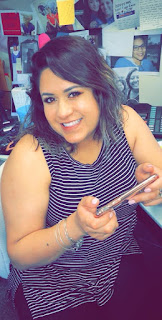
had different qualifications and experiences, but I had an image in my head of what I wanted, and I didn't see that on any of the resumes that I was reading. Often when I hire for a position, I am looking for a particular personality type. I strongly believe that you can teach a person to do a job (any job), but you cannot teach them to be someone that they are not. At the time, I was working hard to build parent contacts, especially among our Hispanic student population, and I thought that having someone up front that could speak Spanish would help me a lot. I had also seen how stressful that job can be and I knew that answering phones was a small part of the position.
 While I had not formally met Liz, I knew her sister from my time at Greene Early College and I had heard several stories about how great of a person she was. She was in school part-time but didn't really know what she wanted to do. She had taken a part-time job working with ESL students at GCMS and I used my connection with her sister to call her. She was unsure about taking the job but I did my best to convince her to interview and we offered her the job quickly after. Her first day was April 1st, and in retrospect, I probably should have waited one more day. I am amazed that she came back after she had to read fake names over the intercom (she realized it with Chris P. Bacon) and was frightened with fake roaches. But she did come back and somewhere along the way, she became part of our family.
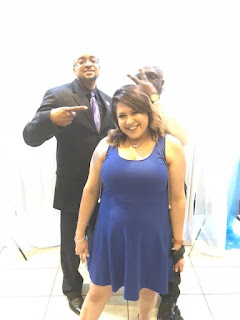 Today we say goodbye to a young woman that has helped us all countless times. She has endured the craziness of the front office. She counsels students when they are upset or sick. She calms parents before they make it to see us. She finds substitutes when we have none and she knows who to call before a fire drill. She helped us build bridges to our Hispanic community, who, for the first time, knew that they could call the school and ask a question about their child. But more importantly, she had the right personality. She knew how to make us all feel better about the place we spend most of our daytime hours. And along the way, she figured out that she wanted to be a school counselor. While I hate to see her leave us, I am reminded that I made her promise that she would finish school when she took the job.

had different qualifications and experiences, but I had an image in my head of what I wanted, and I didn't see that on any of the resumes that I was reading. Often when I hire for a position, I am looking for a particular personality type. I strongly believe that you can teach a person to do a job (any job), but you cannot teach them to be someone that they are not. At the time, I was working hard to build parent contacts, especially among our Hispanic student population, and I thought that having someone up front that could speak Spanish would help me a lot. I had also seen how stressful that job can be and I knew that answering phones was a small part of the position.
 While I had not formally met Liz, I knew her sister from my time at Greene Early College and I had heard several stories about how great of a person she was. She was in school part-time but didn't really know what she wanted to do. She had taken a part-time job working with ESL students at GCMS and I used my connection with her sister to call her. She was unsure about taking the job but I did my best to convince her to interview and we offered her the job quickly after. Her first day was April 1st, and in retrospect, I probably should have waited one more day. I am amazed that she came back after she had to read fake names over the intercom (she realized it with Chris P. Bacon) and was frightened with fake roaches. But she did come back and somewhere along the way, she became part of our family.
  Today we say goodbye to a young woman that has helped us all countless times. She has endured the craziness of the front office. She counsels students when they are upset or sick. She calms parents before they make it to see us. She finds substitutes when we have none and she knows who to call before a fire drill. She helped us build bridges to our Hispanic community, who, for the first time, knew that they could call the school and ask a question about their child. But more importantly, she had the right personality. She knew how to make us all feel better about the place we spend most of our daytime hours. And along the way, she figured out that she wanted to be a school counselor. While I hate to see her leave us, I am reminded that I made her promise that she would finish school when she took the job.
Liz has a difficult job in keeping us all straight, but I think in some way, we served as her internship for counseling. Her experience has been priceless and we have all been better having her here. Thanks for everything Liz.
Friday, October 26, 2018
Eavesdropping

So here was a student, at least 5 years displaced from the classroom, that could recall key information from a high school lesson. While contemporary research speaks volumes about how students are simply memorizing information long enough to test in our age of assessment, this young woman was proving that wrong. Her experiences allowed her to learn things that we associate with standards and vocabulary comprehension, but she knew it only because she associated it with good teaching.
So here's my take away, and I don't think it's going to be what you are expecting. While you might think that I'm talking about active learning or project-based instruction, I'm not necessarily advocating for that. What I am advocating for is this: Do your students associate you with good teaching? If not, it doesn't matter how much planning you did or out-of-seat time they have, the connection was lost. The conversation that I overheard had much more to do with her connection to the teacher than that teacher's methods. There are many of you that have different teaching styles that work for you and may not necessarily work for a teacher down the hall, and that's ok. The question that each of us needs to consistently ask of ourselves, is "Does my style actually work for me?" If not, it's time to change it up!
Friday, October 12, 2018
Stubbornness Can Get You Far
Standing outside of a church, I was a nervous 21-year-old kid in a tuxedo that today I would know didn't fit as well as it should. To break the ice before we went inside, my soon-to-be-wife's father made a joke and told me that I was going to make a great first husband for her. I think a lot of people had that in the back of their minds that day and before. She was only 20 then and we had gotten engaged when she was just 19. We were young and dumb, but you couldn't tell us anything.
My wife, Erika, and I celebrated our 15th anniversary this week, and while that's no huge feat by any means, I do think that it's a bit farther than a lot of people expected back then. We are both very different people today than we were then, but one trait that we both have has remained. We are both very stubborn. We hate admitting defeat on anything. Just ask our kids. We are not above cheating in games with them to win. While that trait is sometimes viewed in the same realm of closed-mindedness, when it is applied positively, we often change the word to persistence.
 Doing something new in your classroom is often not easy. As adults we are resistant to change and even when we know that change could be a good thing, we stop with early obstacles. At the start of the year, Mrs. Garcia issued a 30-day challenge to make your objectives at the forefront of your lessons and in your instruction. Some of you took up that challenge, and others set it aside for now. Some persisted, and others did not. The great thing about it is that you can start again today. If you do start again, try being stubborn about it. Don't think of it as a task or a change. Think of it as a challenge. I'm sure that some of you are like me and if you went into it with the mentality of a parent in a game of monopoly against an 11-year-old, you would do anything to win. Or maybe you're more sentimental. Then you could use the mentality of a 21-year-old kid, stubborn enough to marry a 20-year-old girl, and stubborn enough to make it work. Either way, put your stubbornness to work for you. Sometimes you never know just how far it could take you.
My wife, Erika, and I celebrated our 15th anniversary this week, and while that's no huge feat by any means, I do think that it's a bit farther than a lot of people expected back then. We are both very different people today than we were then, but one trait that we both have has remained. We are both very stubborn. We hate admitting defeat on anything. Just ask our kids. We are not above cheating in games with them to win. While that trait is sometimes viewed in the same realm of closed-mindedness, when it is applied positively, we often change the word to persistence.

Friday, October 5, 2018
She Called My Mom

Some part of that did not seem fair at the time, but there was some genius in it. We do not control how people act or react to us as individuals, but we do always control how we react, even in the midst of adversity. None of what was happening to me in that class felt fair to me at that time, but if I wanted something to change, then I was just as responsible as anyone for changing it. There are many things in life and in our jobs that do not seem right or fair and while we cannot change many of those things, we do control so much of the outcome related to us. If the results you are getting are not what you want, and you can't seem to change the people or events that cause them, then think about your reaction and how that can change to create a new outcome. A new strategy can work and get you what you want in the end.
Friday, September 28, 2018
Clinometers
Over the summer I received a gift from a family member that knew about my appreciation for nautical items. The gift was a ship's clinometer and it sits on a bookshelf on my office. I set it there as something neat to look at and thought that this would be the extent of its use. Little did I know that in the wake of hurricane Florence, this antique would become a metaphor for how our school would progress in the weeks and months after our return.
 Most people do not know what a clinometer's purpose is. On a ship, it measures the incline or depression that the ship takes on the water. On rough seas, it measures the chop of the waves as the ship rises and falls and on calm seas, it can measure how balanced the load on a ship is distributed. If the ship is loaded incorrectly in the front, the ship must plow through more water while the rear of the ship rides much more smoothly, yet inefficiently.
The week and a half of school days lost due to the storm and impassable roads have placed a large weight on the front of our ship. Our fall semester has fewer days and getting material covered, grand challenges presented, certifications earned, benchmarks completed and exams prepped will be a challenge. The front of our ship will have to plow through a great deal of water and along the way, there will be waves. There will be good weeks and tough ones that tip our clinometer back and forth. But while we ride the waves on or unbalanced ship, it's important to note that the ship pushes on. It does not sink and it does not sit still.
The next three months will present us challenges, but rest assured that our crew has the expertise and experience to weather the journey. Your leadership in your classroom and beyond will be called upon to get our precious cargo to their destination. Everyone must play their role. And while the clinometer of our school may be out of balance, it is no match for the will of our school, our staff, our students and our community. Steady as she goes.

The week and a half of school days lost due to the storm and impassable roads have placed a large weight on the front of our ship. Our fall semester has fewer days and getting material covered, grand challenges presented, certifications earned, benchmarks completed and exams prepped will be a challenge. The front of our ship will have to plow through a great deal of water and along the way, there will be waves. There will be good weeks and tough ones that tip our clinometer back and forth. But while we ride the waves on or unbalanced ship, it's important to note that the ship pushes on. It does not sink and it does not sit still.
The next three months will present us challenges, but rest assured that our crew has the expertise and experience to weather the journey. Your leadership in your classroom and beyond will be called upon to get our precious cargo to their destination. Everyone must play their role. And while the clinometer of our school may be out of balance, it is no match for the will of our school, our staff, our students and our community. Steady as she goes.
Subscribe to:
Posts (Atom)